User Post
[Dev] About My Parliament Seats Project
Last edited by disfordave on 25/09/2026, 07:34:04 UTC
User:disfordave / [Dev] About My Parliament Seats Project
Contents
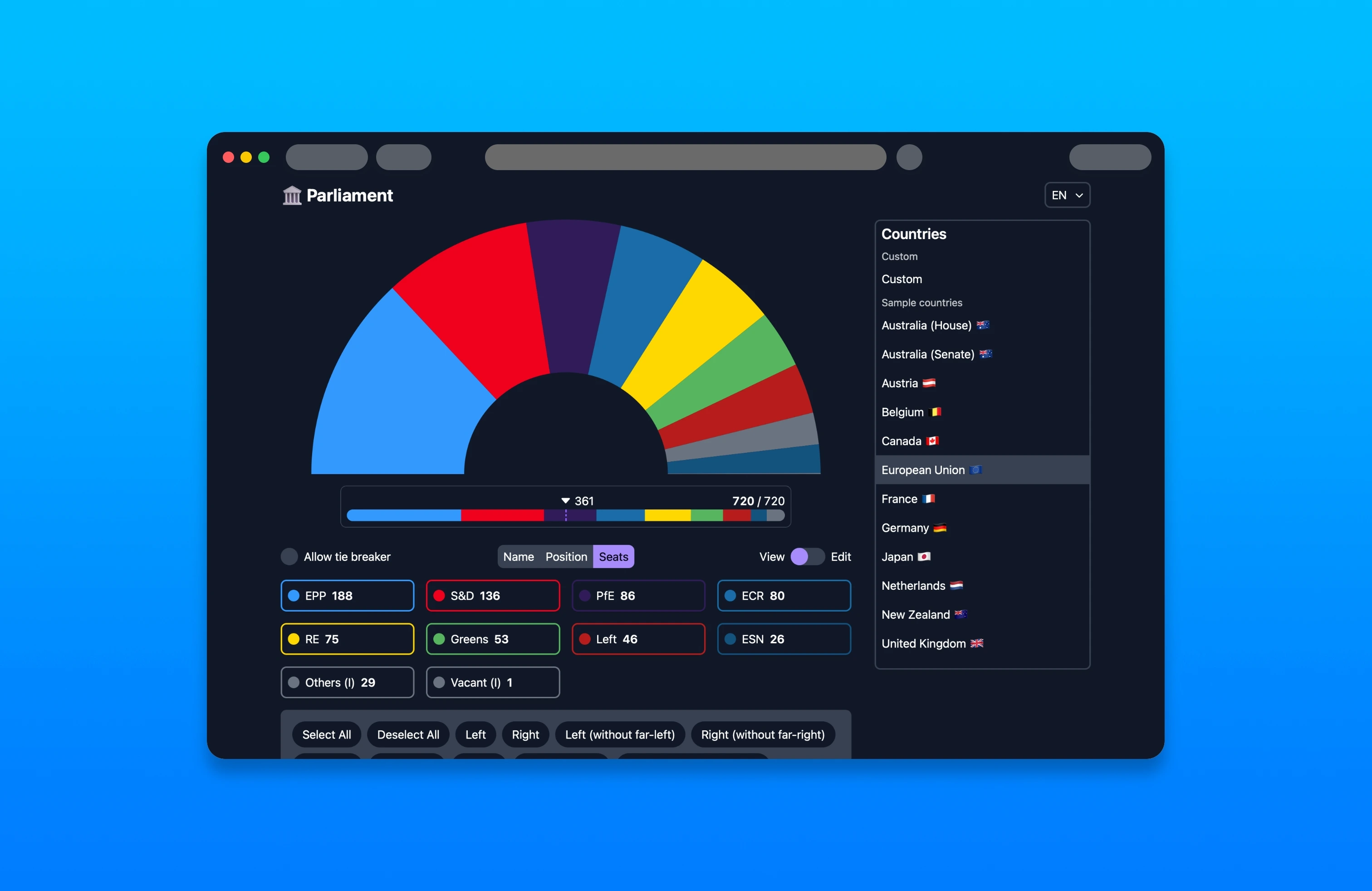
This is a project I feel quite personally attached to — and among all the ones I’ve built, I think it’s the closest to a production-level application (at least in my opinion).
The background behind this project is actually pretty simple. It goes back to 2024, a year full of major elections around the world. I wouldn’t say I’m deeply into politics, but I’ve always been fascinated by elections — often called the “flower of democracy.” In particular, I’ve been intrigued by how parliamentary democracies in Europe form coalitions after elections, often as a semi-mandatory process.
When I wanted to see whether a country could form a coalition easily — or whether it might take ages, like Belgium in 2019 — I realized I needed a simple tool to simulate seat distributions based on each party’s number of seats. As far as I could find, public broadcasters like Germany’s ZDF and Belgium’s VRT offer tools like this on their news sites, and the design of my app was heavily inspired by VRT’s coalition simulator.
Since an interactive seat simulator like this doesn’t really benefit from SSR — you’d basically just end up adding “use client” everywhere and calling it a day — I decided to build it with Vite and React, despite React’s own documentation constantly begging developers to use frameworks like Next.js. If that sounds familiar, it’s probably because I said something similar in my Board Game project write-up.
This project is especially meaningful to me because it’s the first time I properly used Zustand. Zustand is a state management library that allows for global state handling, saving you from endlessly passing down useState props through components. While a regular SPA-based seat simulator could’ve easily worked with simple useState, the real challenge was multilingual support. Since all text in the app needed to change when the user switched languages, managing state via Zustand turned out to be a much cleaner and more scalable solution.
And yes — I’ve actually used this app in real life. During the 2024 European Parliament elections, the 2025 German federal elections, and even during the Japanese prime minister selection in October 2025, I used it to input party seat numbers and explore which coalitions could theoretically form.
I hope this React app becomes a little window through which you can explore your own political imagination — and maybe, just maybe, be reminded of the beautiful value of democracy.
This post was originally published on my personal portfolio website
Backlinks (0)
- General
No backlinks yet.
- User
No backlinks yet.
- Redirects
No backlinks yet.
- Media
No backlinks yet.
- Categories
No backlinks yet.
Categories (0)
No categories assigned to this page.
Edit Level
> User's own page (User:disfordave and admins only)
Latest on Lounge
Join the conversation about the 'User:disfordave/[Dev] About My Parliament Seats Project' article →
No comments yet. Be the first to comment!
Text content on User: pages and its subpages is not licensed under the same terms as regular wiki pages. All rights reserved.